Skip to content
Contact & Community
📍 Metro Manila, Philippines
🌐 robimotoph.com
✉️ hello@robimotoph.com
📱 +63 917 517 0594
📍 Metro Manila, Philippines
🌐 robimotoph.com
✉️ hello@robimotoph.com
📱 +63 917 517 0594

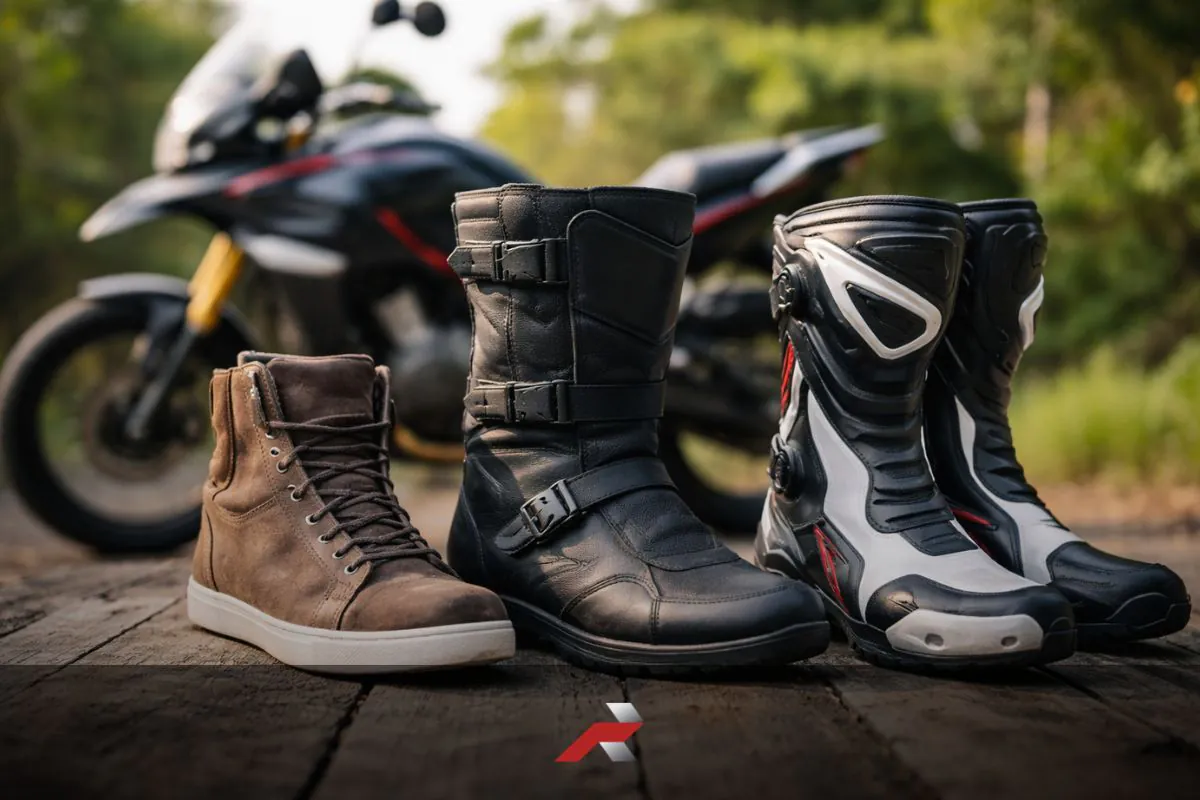
Choosing the right riding boots is not about style. It is about protection strategy. Riding Boots: Casual vs Touring vs Sport is a decision that affects ankle stability, impact resistance, comfort in traffic, and long-distance endurance. Many Filipino riders choose based on looks. Smart riders choose based on usage pattern. This guide breaks down structural differences, safety features, riding scenarios, and cost logic for Philippine conditions. If you ride daily, tour on weekends, or push pace on twisties, this comparison will help you invest wisely and avoid expensive mistakes.
Riding Boots: Casual vs Touring vs Sport is not a style comparison. It is a protection decision that directly affects ankle stability, crush resistance, and long-term riding safety.
Riding boots are structural safety equipment for your lower body.
Your feet support the full weight of the motorcycle at stops. Your ankles absorb rotational force during low-side crashes. Toes often take the first impact during slides.
Choosing the correct category determines how those forces are managed.
In the Philippines, riders deal with stop-and-go traffic, sudden rain, diesel spills, uneven pavement, and unpredictable road behavior. That environment increases the importance of lower-body protection.
Casual boots prioritize flexibility and walkability. Touring boots balance comfort with reinforcement. Sport boots maximize rigidity and torsional control.
Each category serves a different exposure level.
Daily Metro Manila commuters face repeated foot-down strain. Weekend riders encounter highway speeds and long saddle time. Performance-focused riders demand maximum structural support.
If you already optimize helmets and braking systems, footwear must complete the protection chain. For example, braking stability improves when footwear supports proper foot positioning. That connection becomes clearer when reviewing Best Brake Pads for Daily City Riding in the Philippines: A Complete Buyer’s Guide for Big Bike Owners.
Boot stiffness affects brake feel. Sole thickness influences modulation. Ankle rigidity enhances control during emergency stops.
This guide breaks down Riding Boots: Casual vs Touring vs Sport using structural logic, not marketing language.
Before comparing features, define what each type is designed to do. Riding Boots: Casual vs Touring vs Sport becomes clearer when you understand the intent behind each construction.
Casual riding boots are built for daily life. They resemble sneakers or work boots but include hidden reinforcement.
Most models feature:
These work well for short commutes and city riding. Walking comfort matters here because you dismount frequently.
However, impact resistance is limited. Lateral ankle support is also minimal. In a slide, protection coverage is narrower compared to higher-tier categories.
Convenience is the strength. Maximum protection is not.
Touring boots sit in the middle ground.
Manufacturers design them for long-distance comfort while maintaining structural integrity.
You often get:
Flexibility exists, but support increases significantly over casual boots.
These boots handle rain, highway wind pressure, and extended saddle time. Many Filipino riders who travel north or south prefer this category because it balances comfort with real protection.
Sport boots prioritize crash performance and high-speed stability.
Expect:
Mobility decreases. Walkability suffers. Protection increases dramatically.
Track-oriented or aggressive canyon riders benefit most from this structure.
Each category exists for a reason. The key is aligning your riding pattern with the engineering philosophy behind the boot.
Most riders compare price and design. Few examine structural engineering.
Riding Boots: Casual vs Touring vs Sport is about impact management and torsional control. Protection is not aesthetic. It is engineered.
If you are still building your foundation, revisit Beginner Motorcycle Buying Guide: Start Your Ride Right. Smart buying decisions influence long-term safety outcomes. Based on reports, rider preparedness often affects crash survivability more than visual upgrades.
Now let us break down architecture.
Protection is layered.
Casual boots prioritize flexibility and comfort.
Touring boots reinforce shin and ankle zones for sustained mileage.
Sport boots add rigid bracing to resist hyperextension and lateral twist.
Materials change. Internal support changes. Sole construction changes.
When you understand this, the question shifts.
Not which boot looks better.
But which boot manages force correctly for your riding reality.
Protection architecture is strategy, not decoration.
Ankle injuries are common in motorcycle crashes. Twisting force causes more long-term damage than direct impact.
Casual boots often rely on padding only. There is little internal bracing.
Touring boots introduce reinforced medial and lateral supports. These reduce rotation during a slide.
Sport boots take it further. Many use external exoskeleton braces that limit hyperextension and lateral collapse. The rigidity feels restrictive when walking, but that stiffness is intentional.
If your riding involves higher speeds or aggressive cornering, ankle structure becomes critical.
The sole does more than provide grip.
Casual riding boots usually use flexible rubber soles similar to work boots. Comfort is high. Crush resistance varies.
Touring models often integrate reinforced midsoles. This improves durability during long rides and protects against footpeg pressure fatigue.
Sport boots typically include shank reinforcement. This prevents the sole from folding under weight during impact. The design sacrifices flexibility but dramatically improves structural integrity.
If your motorcycle is heavy, crush resistance matters more than style.
Casual boots rarely include hard external shin plates. Protection coverage stays low-profile.
Touring boots add moderate shin guards and rigid heel cups. These reduce direct trauma from debris and impact.
Sport boots maximize coverage. Hard armor wraps around the heel and extends up the shin. Replaceable sliders also protect against abrasion during lean angles.
More armor means more protection. It also means more bulk.
Laces dominate casual designs. Quick to wear. Not ideal for crash retention.
Touring boots often combine zippers with Velcro flaps. Secure and practical.
Sport boots use ratcheting systems or internal lacing mechanisms to eliminate loose material. Stability improves significantly.
A loose boot becomes a liability in a slide.
Protection levels increase as you move from casual to sport. The trade-off is comfort and daily convenience.
Choosing wisely means evaluating how much risk you truly carry on the road.
Specifications look good on paper. Real roads tell the truth.
Riding in the Philippines introduces variables that many global reviews ignore. Heat, humidity, sudden rain, uneven pavement, and dense traffic all influence footwear performance.
Choosing between categories becomes practical once you consider environment.
Stop-and-go riding dominates NCR life. Feet touch the ground frequently. You shift often. You maneuver in tight spaces.
Casual riding boots feel comfortable here. Flexibility reduces fatigue. Walking into offices or malls feels normal.
However, repeated foot-down impact with a 180–220 kg motorcycle can strain ankles over time. Light padding will not help during a sudden slide on diesel-soaked asphalt.
Touring boots perform better in this context. They provide reinforcement without excessive rigidity. Comfort remains acceptable for short walks.
Sport boots, on the other hand, feel overbuilt for traffic. They protect well but may feel stiff during everyday use.
Water changes everything.
Casual boots often lack waterproof membranes. Once soaked, they stay wet for hours.
Touring boots typically include sealed interiors. Waterproofing and breathability matter more than aesthetics during long wet rides.
Sport boots protect structurally, yet ventilation varies by model. Some are not designed for tropical downpours.
If you already prioritize wet braking performance, your footwear choice should align with that mindset. Protection systems work together. For deeper understanding of rain-related safety upgrades, revisit Brake Performance in Wet Roads Philippines: What Riders Must Understand During Rainy Season.
Your gear ecosystem must function as one integrated strategy.
Higher speeds amplify consequences.
Casual boots become the weakest option here. Lateral support is limited. Shin coverage is minimal.
Touring boots handle spirited riding well if speeds remain responsible.
Sport boots excel in aggressive cornering scenarios. Their rigidity stabilizes foot placement during lean angles and emergency corrections.
Each boot category survives in Philippine conditions differently. What works for a short commute may fail during a long provincial ride.
The smartest decision aligns protection level with riding intensity.
Every rider wants both comfort and maximum safety. Reality forces a choice.
Riding Boots: Casual vs Touring vs Sport is essentially a negotiation between mobility and structural rigidity.
Comfort improves when materials flex. Protection improves when materials resist movement.
That tension defines the entire category difference.
Casual boots feel natural off the bike. You can enter meetings, walk around malls, or spend hours standing without discomfort.
Touring boots introduce stiffness but remain manageable for moderate walking.
Sport boots restrict ankle articulation significantly. Extended walking feels awkward. Some riders describe it as wearing armor, which is exactly the point.
If you dismount often, daily practicality matters.
Long rides expose weak gear decisions.
Casual boots may feel soft at first, yet they transmit more vibration from pegs. Extended highway hours can cause foot fatigue.
Touring boots balance cushioning and stability. Pressure distribution improves, especially on heavier motorcycles.
Sport boots lock the foot in place. Stability increases under acceleration and braking, but airflow and flexibility decrease.
Heat buildup becomes noticeable in tropical climates.
Imagine a low-side at 80 km/h.
Soft construction collapses. Reinforced construction resists.
Casual boots protect against minor abrasions. Touring boots protect against moderate impact. Sport boots are designed for severe scenarios.
No boot eliminates risk. However, structure determines damage reduction.
Comfort sells easily. Protection rarely feels urgent until it becomes necessary.
The decision should not be emotional. It should match riding speed, motorcycle weight, and exposure level.
Choosing wisely means accepting that every gain requires a compromise somewhere else.
Understanding Riding Boots: Casual vs Touring vs Sport becomes easier when features are placed side by side.
The differences are not subtle. They are structural.
Below is a condensed technical comparison designed for decision clarity.
| Feature Category | Casual Riding Boots | Touring Riding Boots | Sport Riding Boots |
|---|---|---|---|
| Ankle Support Level | Low (padding only) | Medium (internal reinforcement) | High (external bracing system) |
| Shin Protection | Minimal or none | Moderate reinforced panel | Full hard armor |
| Sole Rigidity | Flexible | Semi-rigid | Rigid with shank support |
| Waterproof Capability | Rare | Common (membrane-based) | Model-dependent |
| Walking Comfort | High | Moderate | Low |
| Crash Resistance | Basic abrasion | Impact + abrasion | High impact + torsion control |
| Best Use Case | City commuting | Long-distance + mixed use | Aggressive riding + track |
| Weight | Light | Medium | Heavy |
Protection increases as rigidity increases.
Mobility decreases as armor increases.
Cost typically rises with structural reinforcement and advanced materials.
Daily commuters benefit from flexibility. Weekend tourers need balance. Performance-focused riders require maximum stability.
There is no universal winner.
The right choice depends on riding frequency, environment, and risk exposure. Use this comparison as a filter before considering brand names or pricing tiers.
Structure first. Branding later.
Marketing language is persuasive. Certification is measurable.
When evaluating Riding Boots: Casual vs Touring vs Sport, structural differences must align with recognized safety benchmarks.
Not all boots undergo the same testing.
In Europe, motorcycle boots may carry CE certification under EN 13634 standards.
This testing evaluates:
Boots are rated in levels. Higher numbers indicate stronger performance under lab stress.
Certification does not mean invincible. It means minimum tested compliance.
According to published safety framework guidance from the European Commission, CE marking confirms that products meet essential safety requirements before entering the market. You can review regulatory context directly through the European Commission’s product safety portal.
That regulatory structure forces manufacturers to meet baseline safety thresholds.
Casual motorcycle boots often resemble lifestyle footwear. Some brands do not pursue full CE testing to reduce production cost.
That decision lowers price but removes verified performance validation.
It does not automatically mean unsafe. It simply means untested under standardized impact metrics.
For daily low-speed commuting, that trade-off may be acceptable. For aggressive riding, it becomes questionable.
Mid-tier touring boots frequently carry CE Level 1 or Level 2 ratings. Sport boots, especially from major performance brands, often meet higher rigidity classifications.
The added bracing systems and hard armor make compliance easier.
Certification also increases consumer confidence during insurance claims and resale scenarios.
Local road hazards include gravel patches, sudden rain, and unpredictable traffic behavior.
Choosing certified footwear adds measurable protection.
Riding Boots: Casual vs Touring vs Sport is not only about category preference. It is about whether the boot has been tested to withstand real crash forces.
Always check labeling. Look for CE marking inside the boot tongue or packaging.
Protection without proof is just marketing.
Price differences between categories reflect engineering complexity, not branding alone.
Casual riding boots typically cost less because construction remains simpler. Padding replaces structural bracing. Flexible soles reduce material density. External armor components are minimal or absent. Manufacturing time decreases, which lowers retail pricing.
Touring boots introduce layered protection. Waterproof membranes increase production steps. Reinforced heel cups and ankle panels require multi-material assembly. Stitch density rises. Zipper and closure systems become more robust. These upgrades justify the mid-range price bracket.
Sport boots sit at the highest tier for a reason. External ankle bracing systems require molded components. Replaceable sliders demand impact-resistant polymers. Internal shank reinforcements strengthen the sole against torsional stress. Each feature adds weight, complexity, and cost.
Durability also affects long-term value.
Casual boots may show creasing and sole compression faster when used on heavier motorcycles. Touring boots maintain structural shape longer due to reinforced midsoles. Sport boots resist collapse under extreme pressure, extending lifespan in aggressive use cases.
Climate adds another variable. Waterproof membranes in touring boots increase price but reduce replacement cycles during rainy seasons. Lower-cost footwear may degrade faster once repeatedly soaked.
Financial efficiency depends on alignment.
If your riding exposure is low-speed urban commuting, entry-level investment may be logical. Regular highway speeds and provincial rides demand stronger construction.
Choosing wisely means evaluating usage intensity, replacement timeline, and safety expectations together.
Cost should follow risk profile.
Head protection gets attention. Foot protection rarely does.
Crash data consistently shows that lower extremities are among the most frequently injured body parts in motorcycle accidents. Ankles, feet, and lower legs absorb impact during slides and trapping incidents.
Riding Boots: Casual vs Touring vs Sport directly influences how those forces are distributed.
During low-side crashes, the motorcycle often pins the rider’s foot momentarily before sliding away. Without torsional rigidity, ankles twist beyond their safe range. Soft footwear collapses under weight. Fractures become more likely.
Research published by the National Highway Traffic Safety Administration highlights that lower limb injuries remain common among motorcycle crash victims. You can review broader motorcycle injury data through official NHTSA reports.
While that data reflects U.S. conditions, physics does not change across countries. Force transfer works the same in Manila as it does in California.
Casual boots primarily protect against surface abrasion. Impact mitigation stays limited.
Touring boots reduce rotational stress and improve crush resistance. Internal reinforcement helps distribute load more evenly.
Sport boots offer the highest torsional control. External bracing restricts unnatural ankle movement during sudden impact.
Many riders underestimate this because feet feel distant from the “main” injury zones. That perception is misleading.
Motorcycles weigh 160 kg to 250 kg in most big bike categories. During a fall, that mass can concentrate on one ankle in less than a second.
Lower-body protection deserves strategic consideration.
Choosing between Riding Boots: Casual vs Touring vs Sport should include understanding injury patterns, not just aesthetic preference.
Protection logic becomes clearer once you acknowledge real crash mechanics.
Choosing correctly becomes easier when you define your riding identity honestly.
Not your dream identity. Your real one.
A daily commuter navigating traffic has different protection needs than a weekend canyon rider. A long-distance tourer faces different fatigue and weather variables than someone riding short urban routes.
This is where clarity matters.
If you want a localized breakdown of weather resistance, comfort, and real-world use cases, review Best Riding Boots for Motorcyclists in the Philippines 2025 | Stay Dry, Ride Safe. The Philippine climate changes the equation. Heat, sudden rain, and humidity demand practical choices, not fantasy setups.
Now match boot type to reality.
Casual boots suit short city rides and moderate speeds.
Touring boots support sustained travel and unpredictable weather.
Sport boots prioritize high-speed stability and aggressive lean angles.
The mistake most riders make is aspirational buying. They purchase for the image they want, not the riding they actually do.
Protection works best when it aligns with behavior.
Define your pattern.
Then choose your structure.
That is how you match boot type to rider profile.
You ride five to six days a week. Traffic dominates your schedule. Stops are frequent. Walking after parking is normal.
Casual riding boots often suit this profile. Flexibility reduces fatigue during repeated foot-down moments. Weight remains manageable. Comfort off the bike stays high.
Touring boots also work if your commute includes expressways.
Sport boots may feel excessive unless you ride aggressively even in city conditions.
Provincial rides. Highway stretches. Variable weather. Longer saddle time.
Touring boots shine here. Waterproof membranes protect during sudden rain. Reinforced ankle zones stabilize your foot during extended riding. Moderate flexibility still allows restaurant stops without discomfort.
Casual boots may feel under-protective at sustained higher speeds.
Sport boots deliver more protection but may reduce comfort during long off-bike breaks.
Twisties. Lean angles. Hard braking. Higher speeds.
Sport boots align best with this profile. Torsional rigidity enhances control. Shin armor increases impact defense. Closure systems secure the foot firmly.
Touring boots can work in spirited riding. Casual boots should not be the default choice here.
Honest self-assessment prevents mismatched gear decisions.
Ride pattern first. Style preference second.
Material selection shapes how a riding boot performs over time.
Full-grain leather has long been the benchmark in motorcycle footwear. Its dense fiber structure resists abrasion effectively during slides. Over time, it conforms to the rider’s foot, improving comfort without sacrificing structure. Proper conditioning prevents drying and cracking, especially in humid climates.
Synthetic microfiber alternatives are engineered for consistency. Unlike natural leather, they do not vary in thickness or grain density. Many sport-oriented boots now rely on advanced synthetics because they maintain stiffness under repeated torsional stress. Weight reduction is another advantage, which becomes noticeable during long rides.
Hybrid construction combines strategic strengths. High-impact zones such as toe caps and heel counters often use reinforced synthetic shells. Flex panels may incorporate textile blends for controlled movement. Waterproof membranes are usually layered beneath outer materials, adding another structural dimension.
Climate also plays a role. Tropical heat demands airflow. Excessively thick leather without ventilation can trap moisture inside the boot.
Industry testing discussions published by RevZilla’s research team show that modern microfiber constructions can match or exceed leather in abrasion resistance when properly layered. Their detailed material comparison can be reviewed here.
Ultimately, material quality must align with the boot category’s intended protection level.
Choosing between categories becomes simpler when filtered through logic instead of impulse.
Riding Boots: Casual vs Touring vs Sport should align with riding intensity, not social media aesthetics.
Start with frequency.
How many days per week do you ride?
Do you enter expressways regularly?
Are provincial rides part of your routine?
Higher exposure demands stronger structural support. Occasional short commutes may justify lighter construction.
A 180 kg motorcycle falling on your ankle creates different stress compared to a 250 kg machine.
Heavier bikes increase crush risk. Stronger boots distribute that force more effectively. Sport and touring models generally offer better resistance under load.
Casual boots may suffice for lighter machines at conservative speeds.
Every rider accepts a different level of risk.
Some prioritize convenience. Others prioritize maximum protection.
Riding Boots: Casual vs Touring vs Sport is not about which category is superior. It is about which category matches your exposure, motorcycle type, and riding behavior.
Once those variables are clear, the decision becomes rational rather than emotional.
Structure over style. Protection over assumption.
Casual riding boots can work for short, low-speed city commutes. They provide basic ankle padding and abrasion resistance. However, structural support remains limited compared to touring or sport boots. Riders who use expressways regularly or ride heavier motorcycles should consider upgrading to stronger, reinforced protection.
Touring boots strike a balance between protection and usability. They feel stiffer than casual boots but remain manageable for walking into offices or restaurants. Most models include waterproof membranes and reinforced ankle panels without extreme rigidity. For riders who mix daily commuting with weekend long rides, touring boots often provide the most versatile compromise.
Sport boots are engineered for maximum ankle stabilization and impact defense. Track riding benefits most from this structure, but aggressive street riding at higher speeds also increases the value of torsional rigidity. If your riding includes hard cornering, frequent highway speeds, or performance-focused behavior, sport boots offer measurable protection advantages. For purely relaxed commuting, they may be excessive.
Waterproofing significantly improves comfort during rainy season riding. Wet socks increase distraction and fatigue, which indirectly affects riding focus. Touring boots commonly integrate membrane systems that resist water penetration while maintaining breathability. Casual boots without sealing often remain damp for hours once soaked.
Lifespan depends on usage frequency and construction quality. Casual boots may show structural softening earlier under heavy motorcycles. Touring and sport boots generally last longer due to reinforced midsoles and stronger ankle systems. Proper maintenance, including cleaning and drying after wet rides, extends durability regardless of category.
Before making a purchase, compare certified models from reputable manufacturers with verified safety ratings. Look for replaceable components, reinforced construction, and local distributor support in the Philippines. Long-term value comes from structural durability, not discount pricing. Investing in properly engineered riding boots often costs less over time than replacing weakly constructed footwear after one demanding season.
Riding Boots: Casual vs Touring vs Sport is not a fashion debate. It is a structural safety decision shaped by riding behavior, motorcycle weight, and exposure level.
Casual boots prioritize flexibility and convenience. Touring boots balance endurance with reinforcement. Sport boots maximize torsional control and impact resistance.
Each category exists to solve a different risk profile.
Filipino riders face dense traffic, sudden rain, uneven roads, and unpredictable driver behavior. Those conditions amplify the need for ankle stabilization and crush resistance. Ignoring lower-body protection shifts risk to one of the most vulnerable joints during a fall.
The correct choice aligns engineering with usage.
Short urban commutes may justify lighter construction. Regular highway speeds and provincial rides demand stronger structural support. Performance-focused riding benefits from rigid bracing systems.
Riding Boots: Casual vs Touring vs Sport becomes clear once you assess exposure honestly. Protection must match reality, not aspiration.
However, boots are only one layer of the system.
If you ride through heavy rain or shifting road surfaces, traction becomes equally critical. Review Best Rainy Season Tires for Big Bikes to understand how wet-weather grip, compound design, and water evacuation channels influence stability. Based on reports, tire performance in wet conditions significantly affects braking distance and cornering confidence.
Smart ownership means building your gear ecosystem intentionally.
Choose based on riding intensity.
Invest according to risk.
Layer protection from the ground up.
That is how disciplined riders make long-term safety decisions.