Skip to content
Contact & Community
📍 Metro Manila, Philippines
🌐 robimotoph.com
✉️ hello@robimotoph.com
📱 +63 917 517 0594
📍 Metro Manila, Philippines
🌐 robimotoph.com
✉️ hello@robimotoph.com
📱 +63 917 517 0594

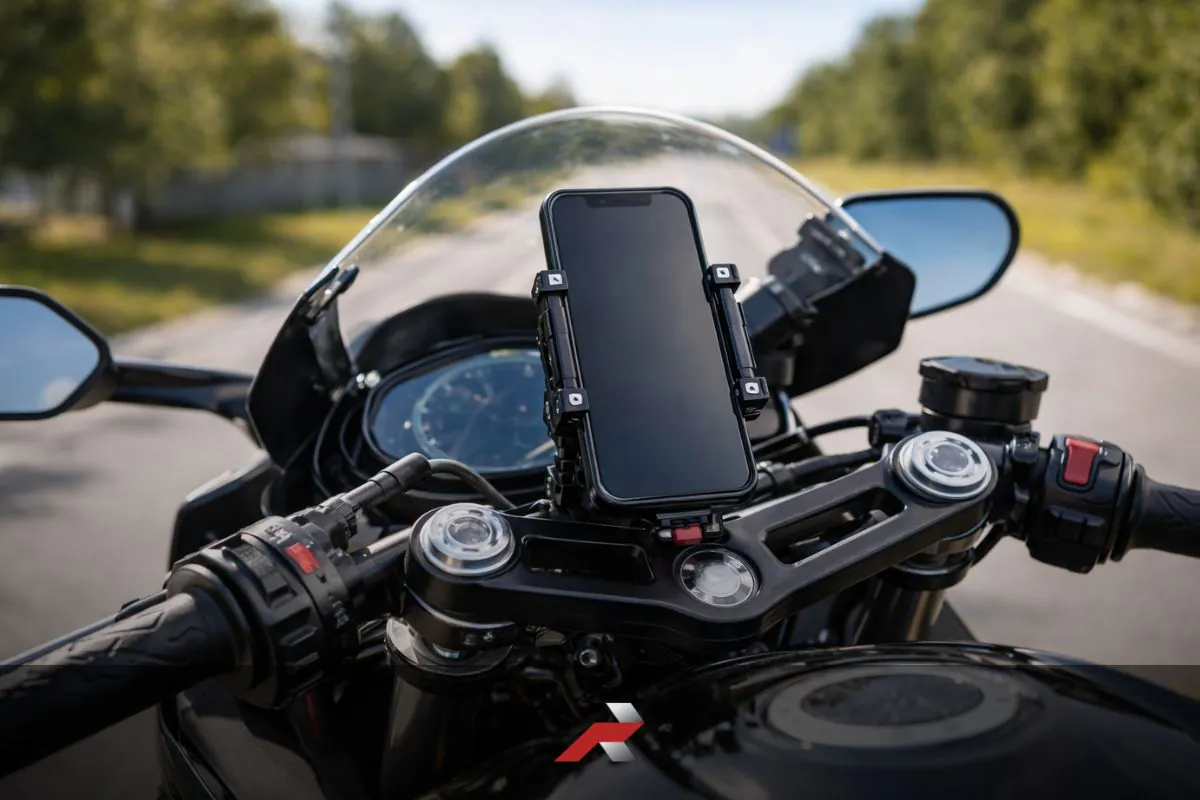
Best Phone Mounts for Big Bikes are no longer optional accessories. They are stability tools, navigation systems, and safety devices rolled into one. In Philippine riding conditions where potholes, vibration, heat, and sudden rain are part of daily life, choosing the wrong mount can damage your phone or distract you at speed. This guide breaks down mount types, vibration control, handlebar compatibility, long ride durability, and real-world commuter insights so you can choose confidently. Whether you ride daily in traffic or tour on weekends, this article helps you buy smart.
Best Phone Mounts for Big Bikes are not about convenience. They are about control, visibility, and protecting a device that now replaces maps, dash cams, and sometimes even your wallet.
On Philippine roads, vibration is constant. Heat is aggressive. Sudden rain is normal. Add uneven asphalt, steel plates, expansion joints, and surprise potholes, and you are mounting a delicate camera module onto a machine built to shake.
That is the real issue.
Modern smartphones rely on optical image stabilization. Continuous vibration from a big bike can slowly damage internal components. Riders often blame the phone brand. In reality, the mount is usually the weak point.
A proper mount must hold steady at highway speed, resist micro-vibration, stay locked during hard braking, survive tropical heat, and maintain screen visibility.
Cheap plastic clamps fail quietly. Bolts loosen. Rubber degrades. Phones tilt mid-ride. That becomes distraction. On a 400cc to 900cc motorcycle, distraction becomes risk.
If you are new to building a proper cockpit setup, revisit Beginner Motorcycle Buying Guide: Start Your Ride Right. The same principle applies here: choose based on real-world use, not hype. Based on reports, equipment failure due to poor mounting systems contributes to preventable riding hazards, especially in high-traffic environments.
Daily riding discipline includes your navigation system.
Your cockpit setup deserves intentional planning.
This guide removes guesswork. It breaks down what actually works for Philippine big bike conditions, so you avoid turning a simple accessory into a mechanical liability.
Because on EDSA at rush hour or on a long ride to Tagaytay, the wrong mount is not a small inconvenience.
It becomes a safety decision.
Not all mounts are built for the weight, torque, and vibration profile of big bikes. A 150cc commuter and a 900cc inline-four create very different stress environments.
Before comparing brands, understand the mounting system category.
These are the most common.
They attach directly to the handlebar using a tightening clamp. Installation is simple. Price is usually affordable. Compatibility is wide.
However, clamp-only systems depend heavily on rubber inserts and bolt tension. Over time, vibration can loosen cheaper versions. Riders often discover this mid-ride when the mount shifts slightly.
For daily city use, high-quality clamp mounts can work. For aggressive riding or long touring, you need more than just grip strength.
Stem mounts attach to the steering stem hole, common on sport and naked bikes.
These systems provide:
They distribute force more evenly compared to side clamp mounts. On big bikes with firm suspension and higher RPM vibration, stem systems generally feel more stable.
If your bike supports it, this is often a stronger structural choice.
Premium systems use a locking mechanism plus a vibration isolator.
This is important.
High-frequency vibration damages smartphone camera modules over time. A dampener reduces that micro-movement before it transfers to the phone.
For riders who:
A dampened system is not luxury. It is preventive maintenance for your device.
Mount type determines safety ceiling. Brand comes second. Structure comes first.
Best Phone Mounts for Big Bikes are defined by structural stability, vibration control, material durability, and real-world survivability in Philippine riding conditions.
Forget marketing claims. Focus on engineering.
A proper locking system must resist three forces:
On a 400cc to 900cc motorcycle, hard braking transfers significant weight forward. A weak clamp will tilt. A weak locking mechanism may partially disengage.
Look for:
Magnetic-only mounts are not recommended for big bikes. They are convenient but lack mechanical retention strength under sudden shock.
High-frequency engine vibration damages internal phone components, especially optical image stabilization modules.
Inline-four engines at highway RPM produce continuous micro-vibration. Even single-cylinder bikes generate sharp pulses.
A quality mount should include:
Without isolation, your phone may appear fine for months. Then one day, the camera refuses to focus.
That is not coincidence. That is physics.
Philippine climate matters.
Heat degrades rubber. UV weakens cheap plastic. Sudden rain tests sealing and grip.
Best Phone Mounts for Big Bikes often use:
Plastic-only mounts fade, crack, or warp over time. They become unreliable silently.
If you ride daily, treat the mount as permanent hardware, not a removable gadget.
Your screen angle affects safety.
Too low, and you look down longer. Too high, and it blocks your instrument cluster.
Proper mounts allow micro-adjustments without slipping under vibration.
A good test:
If you can adjust angle precisely and it holds after 30 minutes of rough road, that is structural integrity.
If it slowly droops, it fails the standard.
This is not about aesthetic setup. It is about long-term reliability.
Not all riders use mounts the same way.
Some ride 12 km daily in city traffic. Others ride 200 km on weekends. Your use case determines your minimum acceptable quality.
City riding in Metro Manila exposes mounts to:
In this environment, rotational stability matters more than extreme wind resistance.
If your mount rotates slightly every day, that micro-movement compounds. Bolts loosen. Rubber inserts compress. Your phone begins to tilt downward mid-week.
For daily riders, prioritize:
This setup complements broader cockpit discipline. If you are refining how you ride within limits, stability matters everywhere.
A stable rider builds a stable machine.
Long-distance riding introduces different stress.
At 90 to 120 km/h sustained speed:
This is where cheaper mounts fail quietly.
Touring riders need:
A mount that survives 20 minutes of city riding may fail after two hours on expressway speed.
That difference is endurance.
Aggressive throttle input and firm suspension increase shock transfer.
Hard acceleration lifts front suspension. Hard braking compresses it. That oscillation stresses mounts repeatedly.
If you ride a naked or sport platform in the 400cc to 900cc range, your mount must tolerate aggressive load cycles.
This is not about brand prestige. It is about physics tolerance.
Daily use defines baseline durability. Touring defines endurance ceiling. Choose based on your real riding life, not just product reviews.
Best Phone Mounts for Big Bikes are chosen through elimination first, brand second.
Start by removing weak options.
If a mount:
It does not belong on a 400cc to 900cc machine.
Big bikes produce torque. Torque exposes shortcuts.
Check diameter compatibility. Many riders skip this and over-tighten to compensate.
Over-tightening damages threads and weakens structure.
If your bike has a steering stem opening, consider a stem system. It centralizes weight and reduces lateral stress.
If you run a wide handlebar, ensure clamp width supports full contact.
Fitment is structural, not cosmetic.
Modern smartphones are heavier than before.
Add a rugged case, and weight increases further. A mount rated for small devices may struggle under repeated bumps.
Best Phone Mounts for Big Bikes clearly specify weight tolerance. If there is no weight rating, that is already a red flag.
A cheap mount replaced twice costs more than a premium mount bought once.
Also consider this:
If vibration damages your phone camera, repair cost is significantly higher than mount price difference.
That alone changes the math.
Buying smart is not about spending more. It is about preventing future expense and distraction.
Mount selection is preventive maintenance for your navigation system.
When evaluating the Best Phone Mounts for Big Bikes, clarity matters. Not all mounts are engineered for high-displacement vibration profiles common on Philippine roads.
Below is a structural comparison that reflects real-world riding conditions.
| Feature | Entry-Level Mount | Mid-Tier Reinforced Mount | Premium Dampened System |
|---|---|---|---|
| Primary Material | ABS Plastic | Reinforced Polymer + Metal Base | CNC Aluminum + Stainless Hardware |
| Locking Mechanism | Spring Clamp Only | Mechanical Lock + Clamp | Dual-Stage Twist Lock |
| Vibration Isolation | None | Basic Rubber Insert | Independent Dampener Module |
| Weather Resistance | Limited | Moderate | High |
| Adjustability Stability | Slips Over Time | Holds Under Moderate Use | Maintains Angle Under Long Touring |
| Recommended Usage | Short City Trips | Daily Commuting | Touring + Expressway Use |
| Long-Term Camera Protection | Low | Moderate | High |
The table reveals something important.
The biggest upgrade factor is not brand name. It is vibration isolation.
Entry-level mounts rely on ABS plastic and simple spring clamps. They work for short city trips but lack long-term camera protection. Mid-tier reinforced systems add mechanical locks and basic rubber inserts. These improve stability for daily commuting.
Premium dampened systems introduce independent vibration modules and stronger hardware. That change directly protects optical image stabilization components from continuous micro-shock.
Without proper dampening, even a metal mount can transmit damaging vibrations.
This principle mirrors another overlooked area of ownership. Security devices also vary structurally, not just cosmetically. Cheap locks rely on simple mechanisms. Higher-integrity units integrate alarm triggers and reinforced housings to resist tampering.
If you want to understand how structural differences affect motorcycle protection beyond cockpit setup, review Motorcycle Security 101: Best Budget Alarm Disc Locks for Pinoy Riders. Based on reports, layered security systems significantly reduce opportunistic theft in high-density urban areas.
Protection is rarely about one component.
It is about engineering integrity across your entire machine.
And mounts, like security devices, should be chosen based on structure, not price alone.
If you ride occasionally, mid-tier may be enough.
If you ride daily or tour frequently, premium dampened systems become protective investments.
Big bikes generate sustained mechanical stress. The mount must absorb part of that stress before it reaches your phone.
This is why serious riders treat their cockpit layout like a system, not random accessories.
The Best Phone Mounts for Big Bikes are those that:
Everything else is temporary convenience.
Best Phone Mounts for Big Bikes must address one critical issue: high-frequency vibration damage.
This is not theory. It is documented.
Modern smartphones use optical image stabilization. Inside your camera module are tiny moving components designed to counter hand shake. They are precise. They are delicate.
When mounted directly to a big bike handlebar without isolation, the engine’s micro-vibration transfers continuously into those components.
Over time, failure happens.
According to a support advisory published by Apple Support, high-power motorcycle vibrations can impact camera systems in certain iPhone models. That advisory alone should shift how riders think about mounts.
This is not brand weakness. It is mechanical exposure.
A 400cc single-cylinder produces sharp pulses.
A 900cc inline-four produces smoother but higher-frequency vibration at sustained RPM.
Both can stress optical stabilization systems differently.
Add Philippine road texture:
Now multiply that by daily commuting.
Best Phone Mounts for Big Bikes include dampening modules specifically designed to reduce high-frequency transmission. That reduction protects camera internals from long-term degradation.
Most riders notice camera issues months later.
Autofocus struggles. Image stabilization shakes. Videos wobble unnaturally.
They assume software glitch.
They rarely look at the mount.
A rigid clamp without isolation may hold firmly. It may look stable. But visually stable does not equal vibration safe.
There is a difference between visible movement and microscopic mechanical oscillation.
If your phone is mounted daily on a big bike:
Best Phone Mounts for Big Bikes are not about holding position only. They are about filtering destructive frequencies.
If your device costs ₱40,000 or more, protecting it is common sense.
Mechanical sympathy should extend beyond your engine.
Most problems with mounts are not product defects. They are selection errors.
Riders often choose based on:
Those are surface factors.
Big bikes require structural thinking.
A mount may feel rock solid when stationary.
That means nothing.
If it does not reduce micro-vibration, your phone camera absorbs continuous stress. Stability is not just about visible shaking.
Invisible vibration is the real threat.
Some riders say they only use navigation sometimes.
But the mount stays installed every day.
Even without active navigation, vibration continues.
If you ride five days a week, buy for five-day durability.
Over-tightening damages threads and compresses rubber inserts prematurely.
Eventually, the mount loosens anyway.
Security comes from design, not brute force.
Mount placement must never obstruct:
• Speedometer
• Warning lights
• Fuel indicator
A clean cockpit improves safety and reduces distraction.
Smart buying is about matching structure to riding reality.
Anything less becomes trial and error. And trial and error at speed is expensive.
Best Phone Mounts for Big Bikes must survive more than vibration. They must survive climate.
Philippine riding conditions expose mounts to:
Cheap polymers degrade under ultraviolet light. Rubber inserts harden. Plastic arms fade and become brittle.
This is not dramatic. It is predictable material science.
Prolonged UV exposure accelerates polymer degradation, reducing flexibility and structural integrity. That applies directly to low-grade plastic mounts left exposed daily.
If your bike is parked outdoors at work, your mount is aging silently.
Heat cycles expand and contract materials. Moisture seeps into seams. UV weakens structural components over time. Eventually, clamps lose tension and vibration control declines.
This same environmental stress affects riding apparel. Waterproof membranes break down. Seams weaken. Coatings lose effectiveness in tropical heat and rain.
If you want a detailed breakdown of how rain gear performs under Philippine climate stress, review Waterproof Riding Jackets Buyer Guide PH: How to Choose the Right Rain Jacket for Big Bike Riders in the Philippines. Based on reports, improper material selection significantly reduces weather resistance lifespan in high-UV regions.
Climate is a structural test.
And in the Philippines, every parked motorcycle is taking it daily.
Heat expands materials.
Expansion reduces clamp tension slightly. Over time, repeated expansion and cooling cycles loosen grip strength.
Best Phone Mounts for Big Bikes use:
These materials resist both corrosion and structural fatigue.
Water intrusion affects moving parts.
Lock mechanisms that trap water may corrode internally.
Look for:
Complex spring-based systems fail faster in humid environments.
The Philippine test is simple:
If it survives daily heat, random rain, and uneven roads for one year without shifting, it is structurally proven.
Anything less is temporary.
Even the Best Phone Mounts for Big Bikes can fail if installed carelessly. Hardware strength means nothing without proper setup.
Do not guess tightness.
Use balanced pressure when tightening bolts. Uneven torque creates stress points that weaken clamps over time.
Avoid using excessive force to compensate for poor fitment. If you must over-tighten to feel secure, the mount is likely incompatible with your handlebar diameter.
Security should come from design precision, not muscle.
Before fully tightening:
Your phone should be visible with minimal head movement. Excessive downward glance time increases distraction risk.
A stable mount also means consistent viewing angle at speed. If it shifts even slightly after tightening, reassess positioning.
Treat your mount like a safety component.
Once a month:
This 3-minute inspection prevents long-term failures.
Installation discipline extends the life of even mid-tier mounts. Neglect shortens the lifespan of premium ones.
Hardware is only as reliable as the rider maintaining it.
Mounting a phone on a big bike is not just accessory installation. It is mechanical integration.
Engineers design motorcycles with vibration control in mind. Rubber engine mounts, counter-balancers, and suspension tuning exist to reduce stress transfer across components.
When you add external hardware, you change that system.
Vibration involves oscillatory motion that transfers energy between structures. Without isolation, that energy propagates directly through connected materials.
Your handlebar is not a neutral surface. It is a vibration pathway.
Best Phone Mounts for Big Bikes work because they interrupt that pathway.
They isolate the device from the handlebar.
Integrated dampeners absorb high-frequency oscillation.
The outcome is reduced vibration transfer to your phone.
Cheap mounts transmit.
Mechanical sympathy means respecting how force travels.
If you respect it for your chain tension and brake pads, respect it for your navigation device too.
A cockpit built with intention reflects a rider who understands cause and effect.
Before clicking checkout, apply these three filters. The Best Phone Mounts for Big Bikes pass all of them without compromise.
Ignore aesthetics initially.
Check material composition, locking mechanism, and hardware quality. If the product description avoids specifying materials or dampening technology, that is a warning sign.
A big bike demands mechanical transparency.
If you ride more than twice a week, vibration dampening is mandatory.
Do not assume “tight grip” equals safe for your camera.
Best Phone Mounts for Big Bikes reduce high-frequency vibration before it reaches your device. That single feature often separates mid-tier from premium options.
Calculate realistically.
If your phone costs ₱30,000 to ₱70,000, protecting it should not rely on the cheapest available mount.
A one-time investment in a structurally sound mount prevents future camera repair or device replacement.
Buying once and buying right is always cheaper than replacing twice.
The safest option for big bikes is a mechanically locking system with a dedicated vibration dampener. Clamp-only systems may hold firmly, but without isolation they transmit micro-vibration directly to the phone. Big bikes generate more sustained vibration compared to smaller displacement motorcycles. A dampened mount reduces long-term camera damage risk while maintaining structural stability at higher speeds.
Yes, it can. Modern smartphones use optical image stabilization modules with delicate moving components. Continuous high-frequency vibration from big bikes can stress those components over time. Damage does not usually happen instantly. It accumulates gradually, which is why many riders only notice autofocus or stabilization issues months later.
Not automatically. Price alone does not guarantee quality. However, premium mounts often include CNC aluminum bodies, dual-stage locking systems, and vibration dampeners. Those features directly address the mechanical realities of big bikes. Evaluate engineering features first before considering price.
In many cases, yes. Stem mounts centralize the device and reduce lateral stress compared to side-mounted clamp systems. They often provide cleaner alignment and improved structural stability. However, compatibility depends on your motorcycle’s steering stem design.
At least once a month. Inspect bolt tightness, rubber dampeners, and angle stability. If you ride daily, frequent inspection is wise. Mounts endure constant vibration and environmental exposure, so small maintenance checks prevent unexpected failure.
Best Phone Mounts for Big Bikes are not lifestyle accessories. They function as structural components within your cockpit system.
A reliable mount safeguards your navigation tool. It also protects your phone camera from long-term vibration damage. Most importantly, it minimizes distraction while riding at speed.
A proper mount must combine mechanical locking strength, vibration isolation, durable materials, and weather resistance suited for Philippine conditions.
Without dampening, the system remains incomplete. Soft plastic construction shortens lifespan under heat and UV exposure. Designs that demand over-tightening usually compensate for poor engineering.
Big bikes produce torque and sustained vibration. Your mount must be engineered to absorb that reality.
Choose based on physics, not popularity.
When your cockpit is stable, your attention stays on the road. And when your attention stays on the road, safety improves naturally.
That is the standard.