Skip to content
Contact & Community
📍 Metro Manila, Philippines
🌐 robimotoph.com
✉️ hello@robimotoph.com
📱 +63 917 517 0594
📍 Metro Manila, Philippines
🌐 robimotoph.com
✉️ hello@robimotoph.com
📱 +63 917 517 0594

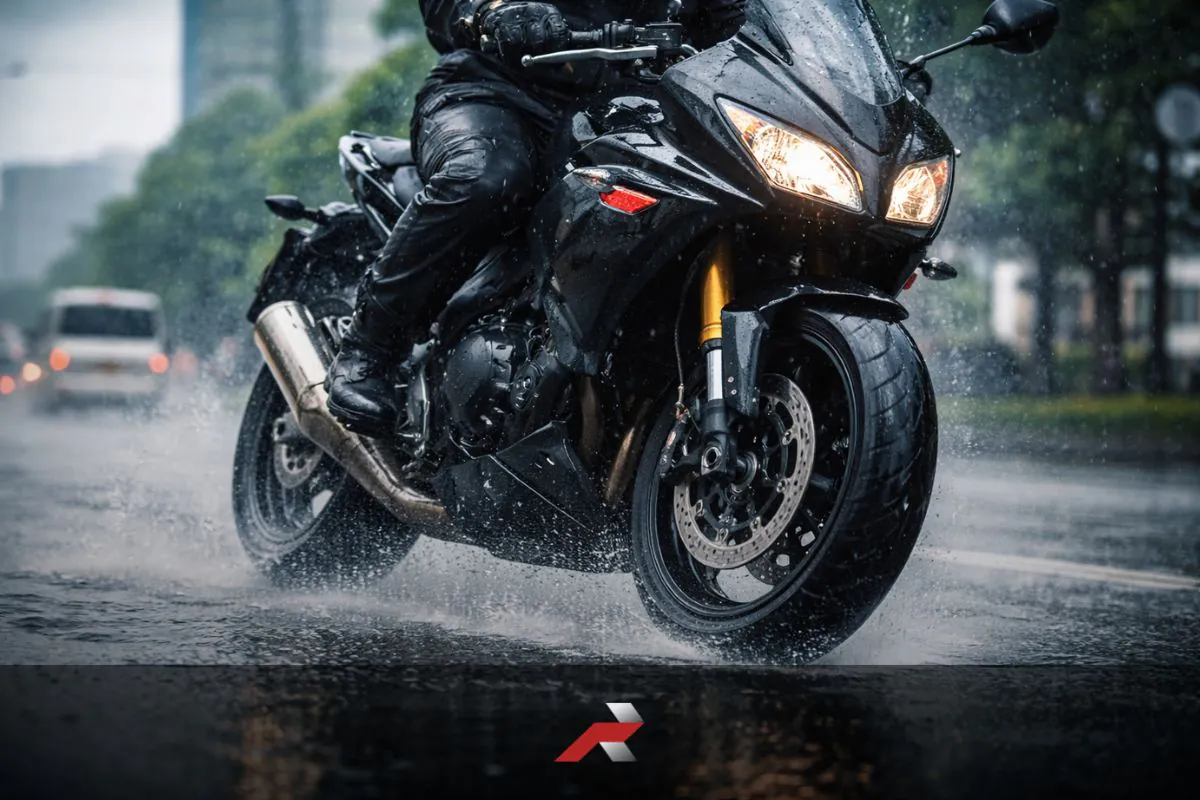
Brake performance in wet roads Philippines conditions changes more than most riders expect. Rain reduces tire grip, increases stopping distance, and affects how brake pads bite against the disc. In daily city commuting, water film, oil residue, and road contamination compound the risk. Understanding how braking force behaves in wet asphalt helps riders adjust technique and choose proper brake pad compounds. This guide explains traction limits, braking distance changes, pad material behavior, and safe control strategies for rainy season riding. Mechanical awareness in wet conditions directly reduces crash risk and long-term maintenance costs.
Brake performance in wet roads Philippines conditions is not just about brake strength. It is about traction limits, surface contamination, and rider input control. In real-world Philippine rainy season traffic, stopping power is determined more by tire grip and road friction than by caliper size or pad brand.
This is part of a broader maintenance framework discussed in the Motorcycle Maintenance in the Philippines: A Real-World Guide for Riders, where braking, tires, fluids, and surface conditions are treated as one system rather than isolated upgrades.
When rain hits asphalt, friction drops immediately. Oil residue rises to the surface. Road markings become slick. Braking distance increases before most riders consciously notice the change.
In Philippine rainy season traffic, stopping confidence depends on controlled inputs and tire condition. Even the best brake pads cannot override physics. Water reduces available grip long before brake hardware reaches its mechanical limit.
Understanding how water changes braking dynamics helps riders avoid panic inputs, sudden weight shifts, and unnecessary performance upgrades.
Rain does not weaken your brakes.
It weakens the surface they depend on.
Brake performance in wet roads changes because the surface between your tire and the pavement changes first. The brake system itself does not suddenly weaken. What changes is the friction environment.
When rain hits asphalt, a thin water film forms on the surface. That film separates the tire rubber from direct contact with the road texture. Even a shallow layer reduces mechanical grip. Brakes can generate clamping force, but if the tire cannot transmit that force to the road, stopping efficiency drops.
Motorcycle braking relies on tire-road friction, not just caliper strength. In wet conditions, traction becomes the limiting factor.
The first 15 to 30 minutes of rainfall are the most dangerous. Oil residue, dust, and fine debris float upward and mix with water. This creates a slick surface similar to diluted lubricant.
Urban Philippine roads, especially high-traffic intersections, accumulate engine oil and fuel drips. When it rains, these contaminants reduce braking consistency dramatically.
Stopping feel becomes unpredictable.
In dry conditions, braking limits are often defined by pad compound and rotor quality. In rain, the tire defines the limit. Even high-performance brake systems cannot overcome poor tire traction.
This is why brake evaluation must be connected to overall ownership discipline. As emphasized in Real Cost of Owning a Big Bike in Philippines, predictable maintenance planning includes tire condition, brake pad life, and seasonal riding adjustments.
Rain does not weaken your brakes mechanically.
It weakens the surface you depend on.
Stopping distance increases significantly in wet conditions, even at moderate speeds. The difference is not dramatic at walking pace, but it becomes measurable above 40 to 60 km/h.
In dry conditions, modern street tires can achieve strong mechanical grip. A controlled emergency stop on dry asphalt allows progressive weight transfer to the front tire. As load increases, traction improves temporarily, enabling shorter stopping distance.
In wet conditions, that traction curve flattens.
| Speed | Dry Stopping Distance | Wet Stopping Distance | % Increase (Wet) |
|---|---|---|---|
| 40 km/h | ~8–10 meters | ~12–16 meters | +30% to +60% |
| 60 km/h | ~18–22 meters | ~28–35 meters | +35% to +60% |
| 80 km/h | ~32–38 meters | ~50+ meters | +40% to +70% |
Assumptions:
Good street tires, proper brake condition, upright braking, no aggressive lean angle.
Values vary depending on:
In dense Metro Manila traffic, even an additional 5 to 8 meters can determine whether you stop safely or make contact.
In real-world brake performance in wet roads Philippines traffic, this difference becomes critical at intersections and sudden stops.
On dry asphalt, braking performance depends mostly on tire compound, pad condition, and rider input. Friction levels remain predictable when the surface is clean.
In wet conditions, available traction drops immediately. A thin water film reduces tire grip. When rain lifts oil and road residue, braking distances can extend far beyond simple percentage estimates.
At 60 km/h, the difference between 18 meters and over 30 meters is not theoretical. It becomes critical in dense traffic.
Weight transfer also behaves differently in rain. Sudden front brake input increases the chance of slip. Riders must brake earlier and more progressively to maintain stability.
The braking system remains mechanically capable. The tire-road interface becomes the limiting factor.
That is the real equation.
Brake pad compound influences wet braking performance more than many riders realize. The rotor, caliper pressure, and ABS system matter. But in rain, pad material determines how quickly friction rebuilds once water sits between pad and disc.
Moisture creates a thin barrier that must be cleared before full braking force returns. Different compounds respond differently to this temporary loss of bite. Some clear water quickly and restore friction faster. Others feel delayed during initial lever input.
Not all compounds react the same way under moisture, temperature variation, and repeated stop-and-go stress. Pad glazing, uneven wear, or contamination can amplify this behavior, especially in daily traffic conditions.
Related braking noise and vibration symptoms are explored in Brake Squealing Causes and How to Fix It in Daily Motorcycle Riding, where pad condition, surface contact, and maintenance timing are examined from a real-world daily rider perspective.
In wet Philippine roads, braking confidence is less about maximum stopping force and more about how predictably friction returns after water exposure.
Organic pads use fiber, resin, and filler materials. They are generally quieter and produce less rotor wear. In dry commuting, they offer progressive feel and smooth engagement.
In wet conditions, however, organic compounds can absorb slight moisture. When the disc is covered in water, initial bite may feel softer until the first squeeze clears the surface film. Riders sometimes describe this as a “half-second delay” before full stopping force develops.
For light 400cc commuters used mainly in city speeds, organic pads can still perform adequately. The key limitation appears during repeated braking in heavy rain. Resin-based materials may heat cycle faster, reducing consistency under prolonged load.
For budget-focused riders, organic pads remain cost-effective. But they require disciplined inspection, especially during rainy months.
Semi-metallic pads combine organic binders with metal particles. The metal content increases thermal stability and improves friction consistency.
In wet roads, semi-metallic pads often clear water film more efficiently than pure organic compounds. The added metallic content helps maintain friction once pressure is applied. Initial bite tends to feel firmer, especially during moderate speeds.
However, increased metal content can produce slightly more rotor wear. In heavy traffic where braking is frequent, that wear becomes a maintenance consideration.
For 400cc to 650cc motorcycles ridden daily in mixed urban and highway use, semi-metallic pads offer a practical balance. They provide stronger wet bite without the higher cost of sintered variants.
Riders who experience frequent heavy rain commuting may find semi-metallic pads more confidence-inspiring than entry-level organic pads.
Sintered brake pads are made from fused metallic particles under high pressure and temperature. They are engineered for high heat tolerance and strong, consistent friction.
In wet conditions, sintered pads typically perform best among the three categories. Their composition resists water absorption. Initial bite remains sharp even after riding through puddles. Friction recovery is faster after sustained braking.
On 650cc to 900cc motorcycles, especially those carrying additional weight or used for touring, sintered pads maintain braking stability under torque and load stress.
The trade-off is cost and rotor wear. Sintered pads can accelerate disc wear compared to softer compounds. For purely urban 400cc commuting at moderate speeds, the performance advantage may exceed practical need.
In Philippine rainy season traffic, pad selection should match riding intensity. Hardware cannot compensate for poor technique. But the correct compound reduces unpredictability when traction is already compromised.
Wet braking is not only about stopping power. It is about consistency under variable grip conditions.
Anti-lock Braking Systems change how motorcycles behave on wet roads. In dry conditions, skilled riders can modulate brake pressure effectively. In rain, surface grip becomes inconsistent. Water, oil residue, and painted road markings reduce traction unpredictably.
ABS prevents wheel lock by rapidly pulsing brake pressure when slip is detected. This maintains wheel rotation and steering control. On wet asphalt, that margin matters more than outright stopping force.
In emergency braking, a locked front wheel on wet pavement can immediately wash out. ABS reduces that risk. Instead of sliding, the tire continues rotating while decelerating near the traction limit. The rider maintains directional stability.
However, ABS does not shorten stopping distance in every scenario. On very low-speed wet surfaces, a skilled rider with precise modulation can achieve similar distances. The difference lies in consistency under stress. Panic inputs often exceed available traction. ABS intervenes when human reaction lags.
For daily commuters navigating Metro Manila traffic, ABS becomes a risk management tool. Sudden jeepney stops, unpredictable lane changes, and pedestrian crossings demand rapid response. In rain, even experienced riders misjudge traction under pressure.
Non-ABS motorcycles rely entirely on rider input. Progressive squeeze, proper weight transfer, and avoiding abrupt lever grabs become critical. On wet roads, over-braking by even a small margin can cause front-end instability.
ABS is not a substitute for skill. It is a safeguard against error.
For riders evaluating braking systems, the decision should be framed around control consistency under stress. Wet emergency stops are rarely planned. They happen suddenly. Equipment that reduces panic-induced mistakes adds practical value over time.
On 400cc to 650cc motorcycles used daily, ABS significantly improves wet emergency stability. On higher displacement bikes, increased torque and higher speeds amplify the benefit further.
In rain, traction is already compromised. Removing wheel lock from the equation allows the rider to focus on line control and escape space.
Hardware cannot eliminate physics. But ABS reduces the cost of misjudgment when roads are slick.
Brake performance in wet roads Philippines conditions is influenced heavily by rider behavior. Even the best brake pads and ABS systems cannot compensate for abrupt or poorly timed inputs. In rain, control begins with discipline.
The most common mistake in wet braking is grabbing the front lever too quickly. Sudden pressure overwhelms reduced traction. Instead of progressive weight transfer, the front tire reaches its grip limit instantly. Stability decreases before the rider can correct.
Rear brake misuse is another issue. On slick pavement, aggressive rear braking can trigger instability. While rear brake assists in balance, it cannot carry the majority of stopping force. Controlled front brake modulation remains essential.
Following distance must also increase. Many riders maintain dry-condition spacing during rain. With longer stopping distance and delayed reaction times, this creates unnecessary risk.
Corner braking requires additional caution. Lean angle combined with braking force reduces available traction margin. In wet conditions, straighten the motorcycle before applying strong brake pressure whenever possible.
Smooth throttle roll-off, early brake initiation, and controlled squeeze define safe wet riding technique. These inputs stabilize weight transfer and preserve traction.
Mechanical upgrades provide consistency. But rider technique determines outcome. Discipline reduces panic. Panic increases error.
In wet conditions, control is not about stronger brakes. It is about measured inputs.
Hydroplaning occurs when a layer of water builds between the tire and the road surface, preventing direct contact with the asphalt. While it is more common in cars due to wider tires, motorcycles are not immune. At higher speeds and with worn tread, hydroplaning becomes a realistic risk.
Motorcycle tires are designed with grooves to channel water away from the contact patch. When tread depth decreases, water evacuation efficiency drops. Instead of dispersing, water accumulates under the tire. This reduces friction dramatically and can cause sudden loss of control.
Speed plays a major role. The faster the motorcycle travels, the less time water has to escape through tread channels. Even moderate speeds can become risky when rain intensity increases and surface drainage is poor.
In Philippine urban areas, uneven road surfaces and clogged drainage systems worsen water pooling. Painted lane markings, steel plates, and manhole covers become particularly slick. When combined with standing water, traction loss can happen abruptly.
Unlike gradual grip reduction, hydroplaning feels sudden. Steering becomes light. Braking response weakens. The motorcycle may drift slightly before regaining contact.
Preventive measures are straightforward. Maintain proper tire pressure. Replace tires before tread depth becomes critically low. Reduce speed in heavy rain. Avoid sudden throttle or brake inputs when riding through visible water accumulation.
Hydroplaning risk increases when maintenance is neglected. Tire condition directly influences braking stability.
Rain changes surface behavior. Tire readiness determines how well you adapt.
Understanding brake performance in wet roads Philippines conditions requires respecting hydroplaning risk, especially during heavy downpours and flood-prone urban areas.
Wet season riding demands more frequent inspection of braking components. Moisture, road grime, and temperature variation accelerate wear patterns. A structured checklist prevents reactive maintenance and unexpected braking inconsistency.
Before heavy rain riding or at the start of the rainy season, inspect the following:
Brake Pad Thickness
Measure remaining pad material. Pads below 40 percent thickness should be monitored closely. Thin pads heat faster and lose friction stability more quickly in wet traffic conditions.
Rotor Surface Condition
Inspect discs for glazing, deep grooves, or uneven wear. Water and debris can accelerate rotor surface contamination. A smooth, clean rotor surface supports consistent braking feel.
Brake Fluid Level and Color
Brake fluid absorbs moisture over time. In humid environments, contamination increases faster. Darkened fluid or spongy lever feel may indicate the need for flushing. Moisture lowers boiling point and affects brake consistency during repeated stops.
Brake Lever Feel
The lever should feel firm and progressive. Excess travel or inconsistent resistance signals possible air intrusion or fluid degradation. Wet conditions amplify small mechanical weaknesses.
Brake Line Condition
Inspect rubber hoses for cracks or swelling. In older motorcycles, degraded lines may expand slightly under pressure, reducing braking precision.
Before entering dense traffic during rain, apply light braking to warm the rotor surface. This clears surface water and improves initial bite.
Rainy season maintenance is not only about hardware. It is about predictable braking response under reduced traction. As discussed in Annual Maintenance Budget Breakdown, preventive inspection stabilizes long-term ownership cost and reduces emergency repair scenarios.
Riders who adjust maintenance frequency during wet months often experience more consistent brake feel and longer component life. Waiting until performance degrades usually results in higher total expense.
Seasonal inspection protects safety margins.
Wet riding amplifies minor mechanical issues. Proactive checks prevent those issues from becoming braking failures.
Many riders assume rain automatically cools braking systems. In reality, wet urban traffic can still generate significant heat. Stop-and-go riding, repeated deceleration, and short recovery intervals create conditions where brake fade becomes possible even in rainy weather.
Brake fade occurs when friction materials overheat and temporarily lose efficiency. In wet traffic, the presence of water on the rotor may initially reduce temperature. However, once the surface clears and braking resumes repeatedly, heat builds again. The difference is that traction remains reduced, so the rider may apply more brake pressure to compensate. That additional input increases thermal load.
In dense Philippine city traffic, riders often brake frequently at low to moderate speeds. Although these speeds seem harmless, repeated braking cycles accumulate heat in pads and calipers. If brake fluid is old or contaminated with moisture, boiling point drops. Lever feel may soften under sustained use.
Lower-quality pads may glaze more easily under mixed heat and moisture exposure. This results in inconsistent bite, especially during repeated stops at intersections.
Wet roads do not eliminate fade risk. They change how it develops. Reduced grip combined with inconsistent friction can create unpredictable stopping feel.
Brake fade in rain is not about high-speed racing. It is about cumulative stress in urban conditions. Consistent pad quality and fresh brake fluid reduce variability.
Riders who understand this dynamic avoid sudden overcompensation.
Upgrading brake components should be based on riding demand, not impulse. In wet Philippine conditions, some riders assume stronger hardware automatically solves longer stopping distances. That assumption is incomplete.
Upgrade becomes justified when riding conditions consistently exceed stock design limits. For example, riders using 650cc to 900cc motorcycles daily in highway rain encounter sustained higher speeds and heavier braking loads. Additional weight from luggage or a passenger further increases stopping demand.
Higher-performance brake pads with improved wet friction consistency may provide more predictable feel under these conditions. Braided stainless brake lines can also improve lever firmness by reducing expansion under pressure.
However, larger calipers or oversized rotors will not compensate for worn tires or poor technique. Traction remains the limiting factor.
Engineering analysis from D.I.D Europe on drivetrain stress explains how load and friction management must align with operating conditions rather than cosmetic upgrades.
The same principle applies to braking systems. Upgrading hardware makes sense when torque load, riding intensity, or thermal demand consistently exceed standard use patterns.
For 400cc urban commuters operating primarily in city speeds, disciplined maintenance often provides more benefit than expensive upgrades.
Upgrade when mechanical stress justifies it.
Maintain when it does not.
Effective braking in rain depends on system balance, not component prestige.
Wet riding changes maintenance frequency. Moisture, contamination, and repeated low-speed braking accelerate wear patterns. Over time, this affects both brake pad lifespan and rotor condition.
In rainy Philippine traffic, riders often apply brakes more frequently due to reduced visibility and increased caution. That repeated friction cycle shortens pad service life compared to predominantly dry riding seasons.
Water mixed with dust forms abrasive residue. If not cleaned periodically, this contamination increases rotor surface wear. Slight glazing may require resurfacing or early pad replacement. Small delays in inspection multiply long-term cost.
Brake fluid also requires closer attention in humid environments. Moisture absorption lowers boiling point and may require earlier fluid flush intervals. Ignoring this adjustment can result in inconsistent lever feel and premature component stress.
From a budgeting perspective, wet season riding should be factored into annual maintenance planning. Replacement timing may shift forward by several months depending on mileage and exposure frequency.
Preventive maintenance stabilizes long-term expenses. Rain does not necessarily increase overall cost dramatically, but it compresses service intervals when neglected. Moisture exposure and contamination accelerate wear patterns, which can move replacement timelines forward if inspection frequency does not adjust.
Riders who adjust inspection frequency during rainy months often avoid emergency repairs. Predictable servicing protects both braking consistency and financial stability.
Seasonal awareness reduces reactive spending.
Wet braking is often misunderstood. Many riders rely on assumptions instead of physics.
Myth 1: Bigger brakes fix wet stopping distance.
False. Larger rotors and stronger calipers increase clamping force. However, in rain, traction is the limiting factor. If the tire cannot transmit force to the road, additional brake power does not shorten stopping distance.
Myth 2: ABS eliminates all wet braking risk.
False. ABS prevents wheel lock but cannot increase available grip. According to safety analysis from the Motorcycle Safety Foundation.
ABS improves control under emergency braking but does not override traction limits.
Myth 3: Rain automatically cools brakes and reduces wear.
False. In stop-and-go urban traffic, repeated braking cycles still generate heat. Water on the rotor evaporates quickly during use, and friction continues.
Myth 4: Engine braking alone is safer in rain.
Partially false. Smooth engine braking helps distribute deceleration. Abrupt downshifts can destabilize rear traction.
Wet braking safety depends on traction awareness, smooth input, and realistic stopping expectations.
Wet braking problems are often caused by behavior, not hardware limitations.
Buying the Cheapest Brake Pads Available
Low-cost pads may work in dry conditions but become inconsistent in rain. Budget compounds can lose friction stability under moisture and repeated braking. Saving a small amount upfront may lead to earlier replacement and unpredictable stopping feel.
Ignoring Tire Condition
Riders sometimes focus on brake upgrades while neglecting tire tread depth. In wet roads, tire grip determines braking success. Worn tires reduce water evacuation efficiency and increase stopping distance regardless of pad quality.
Not Adjusting Following Distance
Maintaining dry-condition spacing during rain increases collision risk. Wet stopping distance is longer. Reaction time often slows in reduced visibility.
Over-Braking at Lean Angle
Applying strong brake input while cornering reduces available traction margin. In wet conditions, this mistake becomes more critical.
Delaying Inspection During Rainy Season
Moisture accelerates wear patterns. Riders who postpone checks often face sudden performance inconsistencies.
Wet braking mistakes are usually preventable. Awareness and discipline reduce risk more effectively than aggressive upgrades.
Wet braking performance also depends on drivetrain stability, which is why chain and sprocket integrity still matter.
Rain itself does not permanently damage brake pads. However, repeated exposure to water mixed with dirt and road contaminants can accelerate wear. Moisture may temporarily reduce initial bite until the rotor surface clears. Regular cleaning and inspection prevent long-term degradation.
When riding through rain, a thin layer of water forms on the rotor surface. The first brake application clears this film. During that brief moment, friction may feel softer or delayed. After surface water disperses, normal braking response typically returns.
Rear brake assists with stability, but it cannot replace front brake stopping force. Most braking power still comes from the front wheel. Overusing rear brake on slick pavement can cause instability. Balanced, progressive input remains essential.
Sintered pads generally maintain more consistent friction in wet conditions compared to softer compounds. Their metallic composition resists moisture-related performance fluctuations. However, proper technique and tire condition still determine overall safety.
During heavy rain months, inspection frequency should increase. Visual checks every few weeks and fluid condition monitoring help maintain consistent performance. Seasonal adjustment reduces the risk of sudden braking inconsistencies.
ABS improves stability, but overall brake performance in wet roads Philippines still depends on tire condition, pad compound, and rider technique.
Brake performance in wet roads Philippines conditions is not defined by brake size alone. It is defined by traction limits, rider input, and maintenance discipline.
Rain reduces available grip immediately. Oil residue, road paint, and pooled water further lower friction. Even well-maintained brake systems cannot exceed the traction capacity of the tire-road interface.
Stopping distance increases. Reaction margins shrink. Small mistakes become larger consequences.
Consistent brake pad condition, fresh fluid, and proper tire tread depth support predictable braking response. However, smooth lever application and increased following distance matter more than hardware upgrades.
ABS improves stability by preventing wheel lock, but it does not create grip. Upgrading components makes sense only when riding demand exceeds stock capability. For most daily commuters, inspection frequency and disciplined technique provide greater safety benefit than aggressive modifications.
Wet season riding in the Philippines requires mechanical awareness and behavioral adjustment. Braking earlier, riding smoother, and maintaining components proactively reduce both crash risk and long-term maintenance cost.
Brake feel degradation in rain is often linked to fluid condition and moisture absorption, a real-world issue explained in Ignored Brake Fluid Replacement and Braking Feel Issues in Daily Riding.
Brake performance in wet roads Philippines environments improves when riders respect physics, plan for longer stopping distance, and maintain equipment consistently.
Control comes from preparation, not panic.